

Case Study: Turning Hidden Square Footage Into Restaurant Profit
The Challenge
A restaurant owner drove up from Fresno with one clear goal: to gain confidence in her plans before construction began.
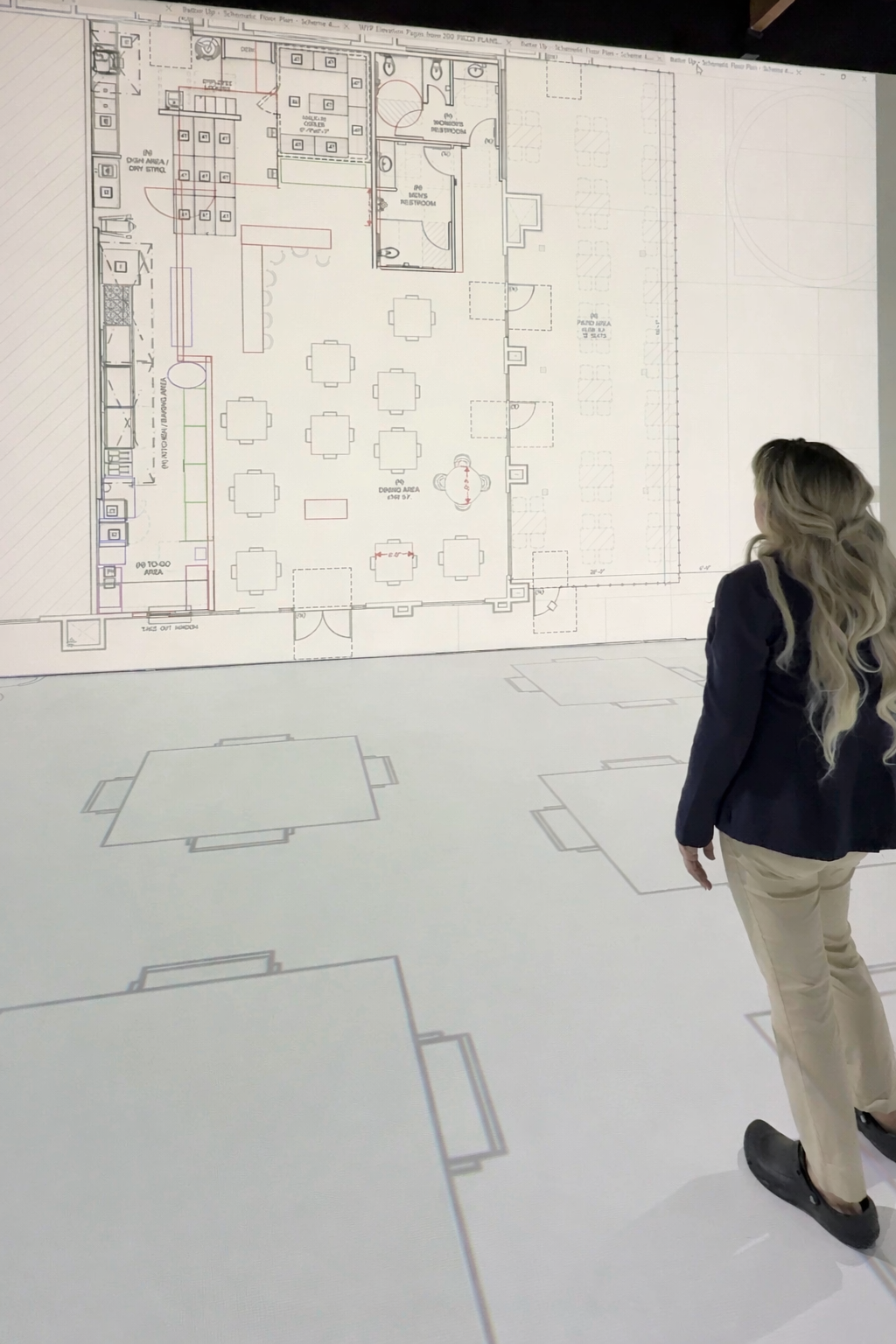
Her architect had delivered drawings, but like many complex restaurant projects, the relationship between the kitchen and dining room was difficult to fully understand on paper. She wanted to walk the space at full scale to confirm the layout and ensure the dining room would support her business goals.
There was unnecessary square footage that wasn’t adding efficiency to the kitchen, but was quietly stealing revenue potential from the dining room.
The Walk
As soon as her plans were projected at full scale and we began walking the space, the issue was immediately clear. Her exact words: “This dining room is too small.” That moment alone justified the trip.
Within the first 10 minutes we made significant changes to the host stand location and added a new large 8-person booth. Together, we continued to walk the restaurant, the kitchen line, circulation paths, storage zones, and back-of-house spaces. In real time, I supported her with redlines and on-the-spot floor adjustments: moving walls, tightening oversized areas, and pressure-testing efficiency as we walked. This gave her the ability to make real-time decisions and she ultimately left confident in her new direction.
The Insight
What looked “fine” on paper revealed a common problem at full scale: the back-of-house was overbuilt. There was unnecessary square footage that wasn’t adding efficiency to the kitchen, but was quietly stealing revenue potential from the dining room. We carefully reduced that excess space without compromising kitchen flow or line efficiency.
The Result
By the end of the session, we had re-allocated over 300 square feet from wasted back-of-house space directly into the dining room. That’s not a design tweak—that’s profitability.
More seats.
Better circulation.
Higher revenue potential from the same lease footprint.
And all of it was solved before construction, not through expensive change orders.
Why This Matters
Restaurants don’t make money in hallways and oversized prep zones. They make money in well-designed dining rooms supported by efficient kitchens. Walking the plans at full scale allowed this client to:
Catch a major layout issue early
Make confident, informed decisions
Maximize revenue-generating square footage
Avoid costly mid-build corrections
Client Review
“Walk Your Plans was hands down the best money I spent on my restaurant project. They helped me truly understand and utilize every inch of my space, pointing out inefficiencies I would have completely missed on paper.
The walkthrough completely changed my game plan — from kitchen flow to seating layout — and allowed me to design a far more efficient, functional, and profitable restaurant. Seeing the plans come to life made decision-making faster and smarter, and it saved me from costly mistakes during build-out.
If you’re opening a restaurant or commercial space and want to maximize efficiency and square footage, I cannot recommend Walk Your Plans enough. Absolutely worth it.”
-Hilary T.
