

Why Our Brains Struggle to Understand Blueprints
If you have ever stared at a blueprint and felt unsure whether you truly understand it, you are not alone. Even intelligent, capable homeowners and business owners struggle to translate flat plans into real-world space. The reason is not a lack of vision. It is neuroscience.
Understanding blueprints requires cognitive skills that most people do not use in everyday life. This article explains why the majority of people find floor plans difficult to interpret and why visualization tools like Walk Your Plans exist in the first place.
Here is what science tells us.

At the core of blueprint comprehension is spatial visualization. This is the ability to mentally rotate objects, understand perspective, and imagine three-dimensional space from two-dimensional drawings.
Blueprints Require Advanced Spatial Reasoning
At the core of blueprint comprehension is spatial visualization. This is the ability to mentally rotate objects, understand perspective, and imagine three-dimensional space from two-dimensional drawings. If you ever took a freshman design or architecture course, this is one of the first skills they begin developing.
For neuroscientists and psycologists, spatial reasoning is measurable. It is assessed using tools like the Mental Rotation Test and other spatial visualization subtests. In large cognitive research summarized by psychologist John B. Carroll in Human Cognitive Abilities (Cambridge University Press, 1993), spatial visualization was identified as a distinct cognitive factor that varies widely from person to person. Engineering admissions testing has repeatedly shown that only a minority of adults score in the high range on advanced spatial visualization tasks. The National Academy of Sciences report Learning to Think Spatially (2006) further explains that while spatial thinking is powerful, it is unevenly developed across the general population.
If you have ever designed for a couple where one person instantly understands the plans and the other feels completely lost, you have seen this difference in real time. In simple terms, spatial reasoning is a specialized skill. Most adults are not trained to use it fluently. When someone struggles to interpret a floor plan, they are being asked to perform mental gymnastics that are not automatic.
Our Brains Are Designed for Real 3D Environments
Humans evolved to understand space by moving through it. We make sense of our surroundings using depth cues like binocular vision, motion parallax, relative scale, and the subtle perspective shifts that happen as we walk from one place to another. That is how our brains are wired to process space. Blueprints remove most of those cues.
Neuroscience helps explain why that matters. Research by Goodale and Milner published in Trends in Neurosciences in 1992 describes two primary visual pathways in the brain. The ventral stream is responsible for recognizing objects. The dorsal stream is responsible for processing spatial relationships and movement. The dorsal stream performs best when it is interacting with real, navigable environments. It is designed to work with motion, depth, and physical context. Flat diagrams provide limited sensory input, which means the brain has to fill in the missing depth information on its own.

Blueprints are not a written language. They are a symbolic language. In many ways, reading a floor plan is similar to looking at hieroglyphs. If you have studied them, the symbols make sense. You recognize patterns and understand what each mark represents. If you have not, you are simply looking at shapes on a page.
That reconstruction takes effort.
Experts and Novices See Completely Different Things
Architects and engineers read plans fluently because they have developed pattern recognition over time. What looks complex to most people feels organized and intuitive to them. Classic research by Chi, Feltovich, and Glaser published in Cognitive Science in 1981 compared experts and novices analyzing technical diagrams. The experts grouped information into meaningful patterns. The novices saw disconnected pieces without structure.
The difference was not intelligence. It was training.
Blueprints are not a written language. They are a symbolic language. In many ways, reading a floor plan is similar to looking at hieroglyphs. If you have studied them, the symbols make sense. You recognize patterns and understand what each mark represents. If you have not, you are simply looking at shapes on a page.
Architects are trained to decode that symbolic system. They see a door swing and immediately understand clearance and circulation. They see a section mark and visualize vertical space. They see scale notation and instinctively grasp proportion.
Most homeowners have never been taught that symbolic language. Without that internal framework, the brain has to consciously interpret each mark before it can imagine the space. That slows comprehension and increases cognitive load.
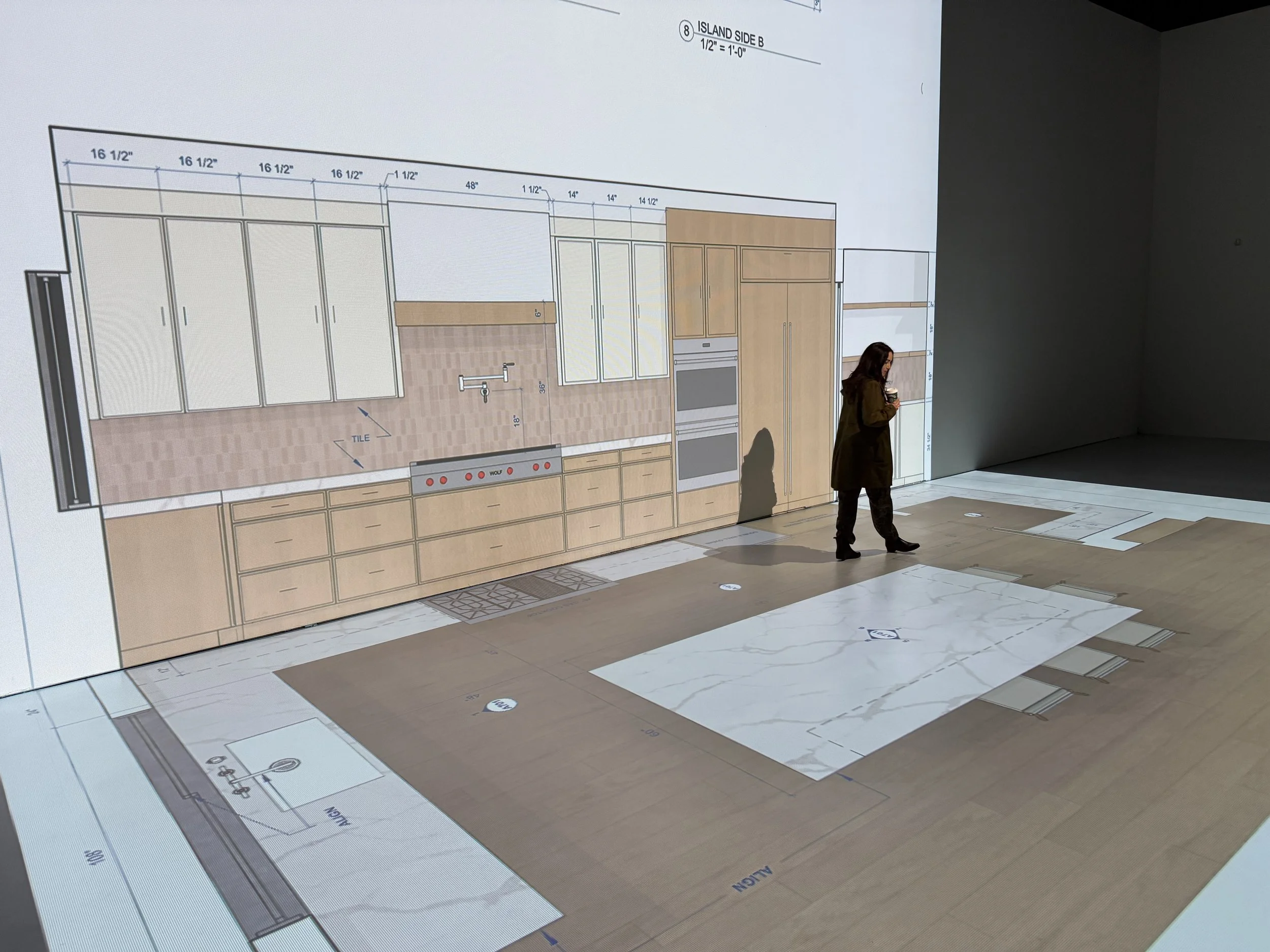
When someone reviews blueprints, their brain is being asked to translate symbols, reconstruct depth, manage working memory, and visualize lived experience all at once. That is a significant cognitive demand. And when cognitive demand is high, uncertainty follows.
Why This Matters Before Construction Begins
Pre construction is the process of planning your build or project before a shovel hits the dirt or the first hammer is swung. During this stage, homeowners are asked to review an enormous amount of information and make meaningful decisions that will shape how they live or work in the space.
It is not just about finalizing drawings. It is about building confidence before real money, materials, and timelines are on the line.
When someone reviews blueprints, their brain is being asked to translate symbols, reconstruct depth, manage working memory, and visualize lived experience all at once. That is a significant cognitive demand. And when cognitive demand is high, uncertainty follows. Uncertainty is where hesitation, second guessing, and change orders begin.
But when clients can physically experience a space at full scale, the brain is no longer guessing. It is no longer reconstructing depth or imagining circulation. It is perceiving space directly, using the same visual and motor systems it relies on every day. That shift matters.
Clarity increases because spatial understanding becomes immediate rather than abstract. Decisions move forward because the experience feels real instead of theoretical. Risk decreases because issues surface before construction, not during it. This is not about preference. It is about how the brain processes information.
Blueprints will always be essential technical documents. But if the goal is shared understanding between homeowners, designers, and builders, then the medium must align with human cognition. When we match the tool to the brain, confidence follows.
